

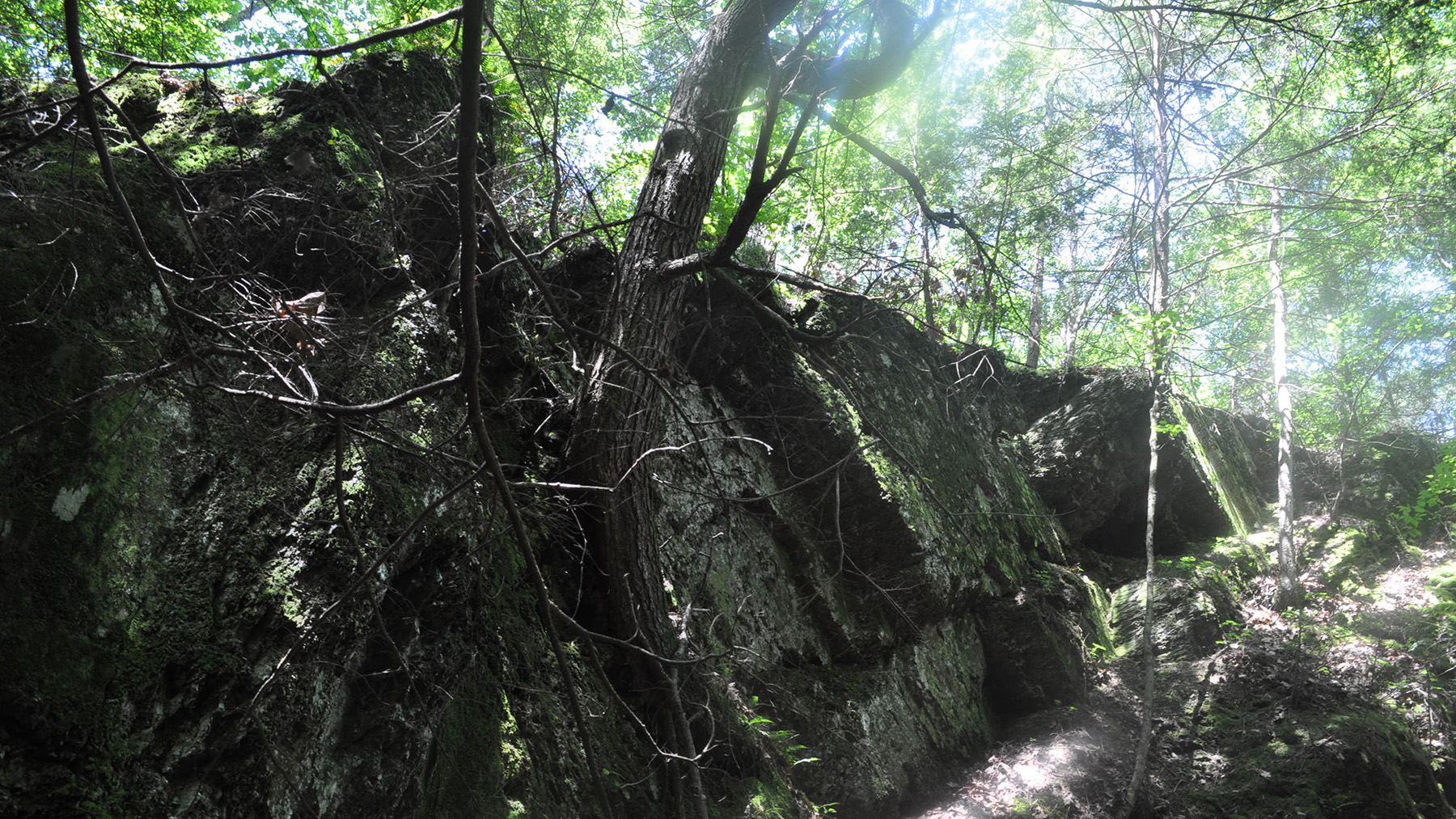
On a semi-warm November afternoon, I, alongside the four other environmental education interns, took a hike from Shaver’s Creek Environmental Center to visit Dark Cliffy Spot in Stone Valley. I had yet to see this location, but I knew before even going that I wanted to capture it in some form after reading about it in several Long-Term Ecological Reflections (LTERP). I am quite amazed by what I saw, and I believe the location stands up to the wonderment posited by the reflectors. Once we arrived, my eyes immediately scanned the steep rock face. At the bottom of the wall, there was an immense amount of snakeroot blanketing the area where water meets shale. As the eye travelled upwards, maidenhair spleenwort, columbine, and a variety of lichens filled one’s view, creating a beautiful green tapestry. Continuing even further, near the top edge of the cliff, a white pine tree could be seen jutting out of the rocks, its branches standing strong against its awkward positioning. I knew I chose right by wanting to depict this habitat.
The Dark Cliffy Spot itself is a shale rock face overlooking a stream. This type of habitat has a bit of importance in the surrounding area through it being a part of the Susquehanna Shale Hills Critical Zone Observatory. The “Observatory” was established to explore how the environment functions from canopy to groundwater. For the sake of this project, I am only focusing on a small portion of this land and its functions. However, Dark Cliffy Spot serves as a wonderful demonstration of the process of succession through the plants that cover its rock face. To take you on this adventure, I have chosen to highlight four plants that I either saw myself or read about in the LTERP blogs. These plants were picked because I felt genuine excitement to learn more about them and to see them for myself.
Common Liverwort (Marchantia polymorpa)
In the tale of succession on a rockface, the first plant that appears following the spread of lichen are bryophytes such as the common liverwort. Bryophytes are characterized by their unique growth patterns as they go through both sexual and asexual reproduction. Gemmae cups are used in asexual reproduction, allowing this species to propagate itself using “splash cups.” These cups hold the rounded budded gemmae which are knocked loose via rain. These buds, when knocked off, form new liverworts. The shape of the gemmae is where the plant’s common name came from as they have a similarity to human livers. Sexual reproduction occurs through branches that grow vertically. The female branches look like parasols while the male branches are smaller and look more like those rounded bubble umbrellas. The spores these branches form are yellow and spread upon contact after reaching maturity. The shape and characterization of these parts felt completely unknown to me and drew me in at first glance.
Liverworts, in general, tend to grow on wet rocks or in well-watered soil. Spectacularly, common liverwort also tends to be one of the first plants that appear following a fire. It spreads quickly and helps prevent soil erosion. It also builds up the soil ecology so that other plants can return to the area. Once they do, liverworts typically cannot outcompete the other foliage. They come in moments of environmental disaster, help rebuild, then leave so that original or new inhabitants can move in. On rock faces, such as Dark Cliffy, liverworts help lichens in their journey to break down rock to make soil. Alongside their soil-making prowess, Liverworts also lack a vascular system, which makes these plants successful bioindicators as they are susceptible to water and air changes.
Maidenhair Spleenwort (Asplenium trichomanes)
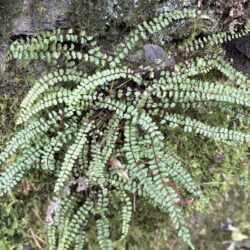
Following lichen and liverworts, the next type of plant to arise on rock faces are the ferns, which is where maidenhair spleenwort falls. This plant typically finds itself filling shady calcareous rock crevices within a wall. It juts out of the hole and gives the rocky surface a gorgeous green feathery look. If you were to peak under the fronds of spleenworts, you could see the many yellow spores that make up its propagation method. Its genus name Asplenium, or “spleenwort,” is derived from the Greek word for “spleen.” The title comes from the traditional use of the species in medicinal practices to treat spleen problems. One group who used spleenwort in this way were the Cherokees. To me, the common name of “maidenhair” also fits this plant perfectly as the stems look like close-up images of bronze hair follicles. Sadly, not much information is written about this species of fern, however, ferns in general tend to be hailed as quite important for their environmentally restorative abilities.
Wild Columbine (Aquilegia canadensis)
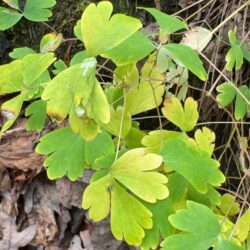
The next chapter of rocky succession occurs with wild columbine. Considered an herbaceous perennial, wild columbine tends to appear in moderately rocky moist soils in and around steep stream banks or in open wooded areas. In the eastern United States, it is the only native columbine species. Both its genus and common name derive from Latin words that relate to animals. Aquilegia means eagle, which apparently comes from the plants’ spurs that look like talons. Columbine translates to dove as its flower shape is said to look like a dove’s head bending down to get a drink of water. The plant flowers in the spring, but its leaves stay green year-round. Columbine’s narrow red flowers appear to be the perfect spot for ruby-throated hummingbirds to come and collect nectar, pollinating the plant as they do so. Its leaves are not ingested by mammals, but they do fuel certain caterpillar species such as dusky winged butterflies. Red columbine’s seed were used in a variety of ways by the Meskwaki people, but one of those most noted was the seeds’ ability to perfume tobacco. I mention the use of seeds because the star-shaped seed pods have intrigued me dearly, especially since they have been described as “rattle-boxes.”
Downy Rattlesnake Plantain (Goodyera pubescens)
Downy rattlesnake plantains are a member of the orchid family, one of the most widespread and diverse families of plants in the world. In United States forests, this family tends to be rare or threatened, making the finding of this plant feel particularly special. The plant is an evergreen perennial herb. Its name, both scientific and common, relates to its appearance in some form or fashion. Pubescens references the downy hairs on the plant’s stem, giving its stalk a soft look. “Rattlesnake” and “plantain” both come from the formation of the leaves. Rattlesnake stems from the brilliant white lines decorating the bold green of the leaf, while plantain is derived from the Latin word “planta” which describes the sole of a human foot. As the leaves are visible year-round, it makes sense that one would use them to name this gorgeous plant. As is common with orchids, this plant also forms mycorrhizal connections with fungi, allowing a symbiotic relationship to form where each organism gets its needed nutrients. Some Algonquian-speaking Indigenous tribes and nations used the mashed leaves of the downy rattlesnake plantain to prevent mouth soreness in infants. Now, we mostly use these plants in our own gardening efforts. While the leaves are beautiful, what interests me the most is how the forest floor looks when a colony of these plants flower. The many rows of tall, straight, downy stems and white flowers must be a sight.
References
Brantley, Susan, Tim White, Nicole West, et al. “Susquehanna Shale Hills Critical Zone Observatory: Shale Hills in the Context of Shaver’s Creek Watershed.” Vadose Zone Journal 17, no. 1 (2018): 1-19.
Dutta, Tusheema and Hasan Ikbal. “Ferns from Folklore to Pharmacy: Ethnopharmacology of Pteridophytes.” In Ferns: Growth, Diversity and Ecological Importance, edited by Shobhit Kumar Srivastava and Gyan Prakash Srivastava. NOVA Science Publishers, 2023.
Eastman, John. Forest and Thicket: Trees, Shrubs, and Wildflowers of Eastern North America. Stackpole Books, 1992.
Hamel, Paul and Mary Chiltoskey. Cherokee Plants and Their Uses – A 400 Year History. Self-published, 1975.
Hayden, John. “Wildflower of the Year 2016: Downy Rattlesnake Plantain (Goodyerapubescens).” Virgina Native Plant Society. Accessed November 20, 2025. https://vnps.org/wildflower-of-the-year-goodyera-pubescens-downy-rattlesnake-plantain/.
Marquesen, Susan. “Liverwort: An Ancient, Primitive, and Persistent Plant.” Penn State Extension. Last updated September 23, 2025. https://extension.psu.edu/liverwort-an-ancient-primitive-and-persistent-plant.
Matthews, Robin. “Marchantia polymorpha.” In Fire Effects Information System. U.S. Department of Agriculture and U.S. Forest Service, 1993.
Munch, Susan. Outstanding Mosses and Liverworts of Pennsylvania and Nearby States. Albright College, 2006.
Sanders, Jack. Hedgemaids and Fairy Candles: The Lives and Lore of North American Wildflowers. Ragged Mountain Press, 1993.
Sessa, Emily. Ferns, Spikemosses, Clubmosses, and Quillworts of Eastern North America. Princeton University Press, 2024.
Sharpe, Joanne, Klaus Mehltreter, and Lawrence Walker. “Ecological Importance of Ferns,” in Fern Ecology, edited by Klaus Mehltreter, Lawrence Walker, and Joanne Sharpe. Cambridge University Press, 2012.
Smith, Huron H. “Ethnobotany of the Meskwaki Indians.” Bulletin of the Public Museum of the City of Milwaukee 4, no. 2 (1928): 175-326.
Sprout, Susan. “Underfoot: Rattlesnake Plantain.” Northcentral Pennsylvania Conservancy. Last updated December 1, 2021. https://npcweb.org/underfoot-rattlesnake-plantain/.
Tantaquidgeon, Gladys. Folk Medicine of the Delaware and Related Algonkian Indians. The Pennsylvania Historical and Museum Commission, 1972.
Wheeler, Ben. “Aquilegia canadensis (Wild Columbine/Eastern Red Columbine) Ranunculaceae.” Lake Forest College. Last accessed November 20, 2025. https://www.lakeforest.edu/academics/majors-and-minors/environmental-studies/aquilegia-canadensis-(wild-columbineeastern-red-columbine)-ranunculaceae.