

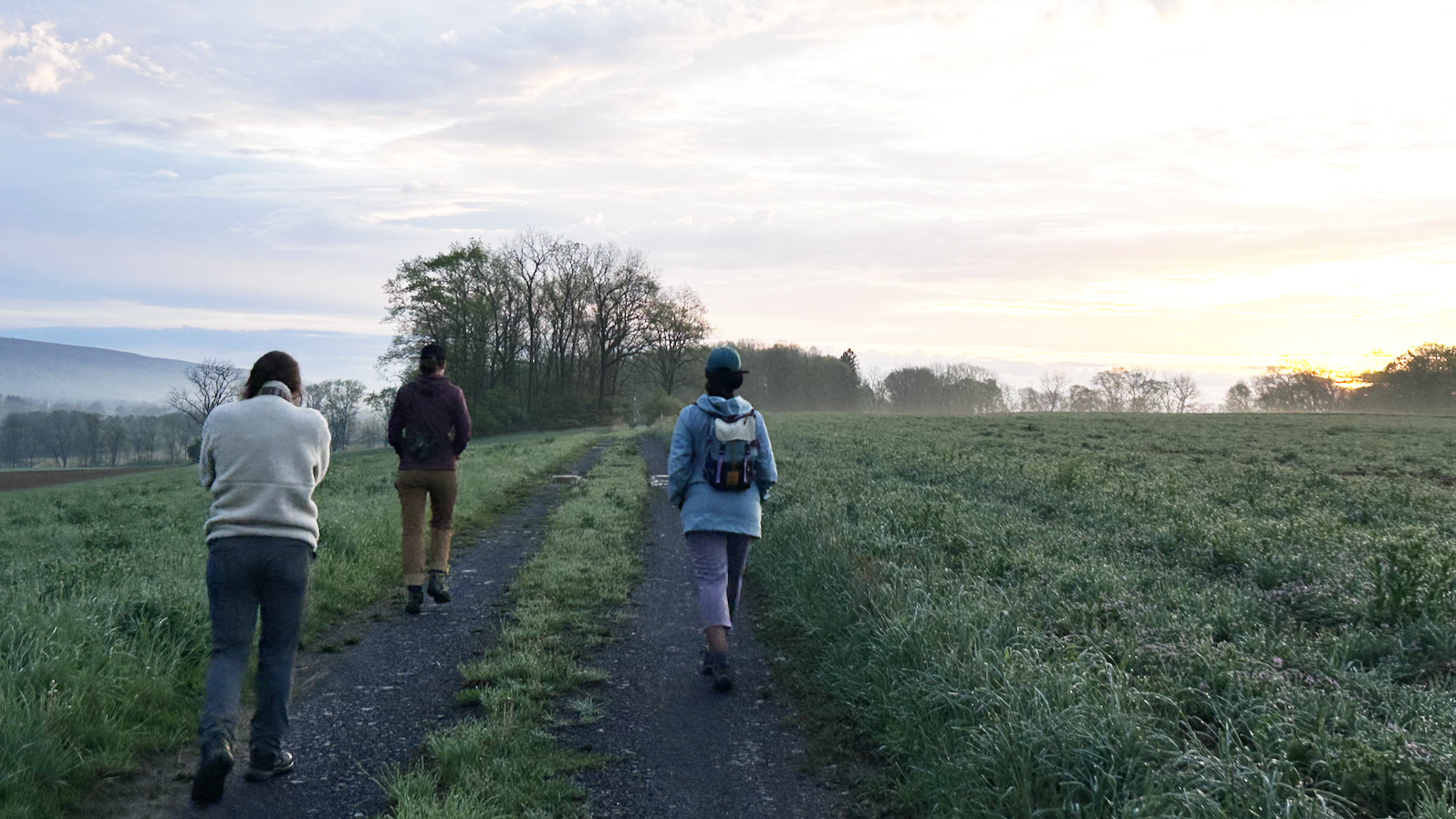
Jen: Meeting at Rhoneymeade on a Sunday in April, we looked at maps, discussed strategy, planned menus, and strolled the two-mile loop. Being that it was a warm day before the busiest time of migration and our mid-day timing wasn’t best for hearing and seeing birds, it was difficult to gauge if we were making a wise choice with our Birding Cup location. I was a little concerned when the landscape was relatively quiet, but Alexa reassured me that the birds would show up for us.
As the days passed, Alexa biked some of our possible routes, I spent more time walking the trails and scouting the nearby areas, and Autumn and Jasmine brushed up on their bird knowledge by poring over recordings of songs and calls and images of birds we might see. We looked at maps to find habitat diversity, knowing that the more variety we could visit, the higher our count of birds could be.
Alexa found, on her bike routes, that there were long stretches of field and farmland. While these areas could be good for certain birds including meadowlarks, soaring raptors, sparrows, pipits, horned larks, bobolinks, and bluebirds, we needed to consider balancing our time, getting to forest, lake, and stream habitats. Her research aided in changing our plan from doing the competition in the non-motorized category (The Birding Boot) to competing for The County Cup by staying in Centre County.
Over years of participating in The Birding Cup with and for Shaver’s Creek, I have discovered that my passion and interest lie in focusing on understanding and being fully present in a more localized area, rather than driving many miles to strive for the highest number of birds. Feeling more connected to my team and to the land makes the experience rich for me. Different teams have different goals, and I’m delighted to have found like-minded women to celebrate the moments as we went along.
We gathered at Rhoneymeade at 5:30 p.m. on Friday, May 2, to set up our “kitchen” area and sleeping spaces and to spend some time together sharing a meal and setting intentions before the 7:00 p.m. start time. The weather was lovely, and we soaked in the sun as we sat outside, eating and chatting. The birds were singing—many more than on that April day when we first gathered here—Alexa was right! Knowing that the birds are changing daily at this time of year is a challenge and a delight. Birds that we didn’t hear when scouting a couple of days ago, or even a few hours ago, may have now arrived!
At the stroke of 7:00 p.m., the evening was wrapped in song, and we started counting as we became more aware of the wings flitting above us. Orioles, swallows, woodpeckers, and other songbirds pierced through the absolutely relentless robin calls. The species really racked up fast in the beginning—as we walked the trails through the meadow near the studio, we noted Carolina Wrens, Eastern Bluebirds, Tree Swallows, Barn Swallows, and Field Sparrows. As the sky darkened and we considered the evening and nighttime species that we wanted to look for, we chose to save the field loop for morning, and we set off for Penn’s Prairie because Alexa was familiar with this spot for evening birding. We walked the loop, hoping to hear an American Woodcock, listening intently through the wind to hear a lone Savannah Sparrow calling from within the stubby stalks of the meadow.
We drove from there along a beautiful, wooded road named Blackhawk Gap. Hoping to hear owls, we stopped frequently to stand in the darkness, hands cupped behind our ears to enhance our hearing capabilities. In these moments, the desire to hear a distant Great Horned Owl becomes so great that my imagination can create the distinct hooting pattern “whoo-who-who who-who” in my head SO clearly that I’m certain that I’ve really heard it. It’s good to have teammates to check me in these cases! We did hear a very distant but distinct “Whip-poor-will! Whip-poor-will!”—a favorite spring sound.
While we were parked and listening, a kind gentleman in a truck pulled up to check on us and the state of our vehicle. When we explained that everything was fine and what we were doing, he quickly offered, “Oh! I know where there are owls! Follow me!” Because of the rules, we could not accept his help, but we still thanked him and he went on his way.
A Shaver’s Creek coworker of ours, Jon Kauffman, works with landowners on Barn Owl boxes and research. Alexa had talked with Jon about where he had placed boxes in the valley and we, sneakily, went to sit in a driveway of a home and stared intently at the opening of the box (when not glancing at the house to make sure people weren’t coming out!). Staring and staring hard has the same effect for me as listening hard—my imagination can conjure Barn Owls—but sadly, we did not count any that evening.
So, we had to choose—do we continue this quest for nocturnal species? Or do we go back and settle into our cozy nests in the Rhoneymeade Studio to catch some rest? We voted for a rest. Autumn and Jas went to their homes to sleep and take care of home things while Alexa and I enjoyed the studio. I have learned that the second portion of The Birding Cup—waking early, being out all day, returning to the center to celebrate—is much more enjoyable with a good night’s sleep, which is exactly what I got, beginning the moment I laid down.
Autumn: The team reconvened around 6:00 a.m., well rested. After some yummy breakfast and lounging around the Studio, we were off!
The sky melted into color and early morning light reflected off the curling steam as it streamed from our coffee cups. We started at Rhoneymeade, our boots collecting morning dew. We walked slowly, each noise causing us all to pause and tilt our ears toward the sound. Our eyes searched one another’s in questioning glances until one person would pierce the silence with a whisper of identification.
Alexa: As the glowing sun rose over the horizon, we made our way slowly on the path along the top of the fields past the barn, listening to a Grasshopper Sparrow singing its insect-like song from a hidden perch in the low growth of the fields below us. We approached a patch of woods and spent several minutes searching for a small warbler calling in the treetops, until we were finally rewarded with the sight of a tail-bobbing Palm Warbler.
As we made our way down along the wood line on the lower edge of the fields, we were delighted to realize that we heard or saw each member of the woodpecker family that can be seen in Pennsylvania, collecting, in Shaver’s Creek lingo, a “woodpecker sweep” of a Pileated, Hairy, Downy, Red-bellied, and Red-headed Woodpecker, as well as a Yellow-bellied Sapsucker and Northern Flicker!
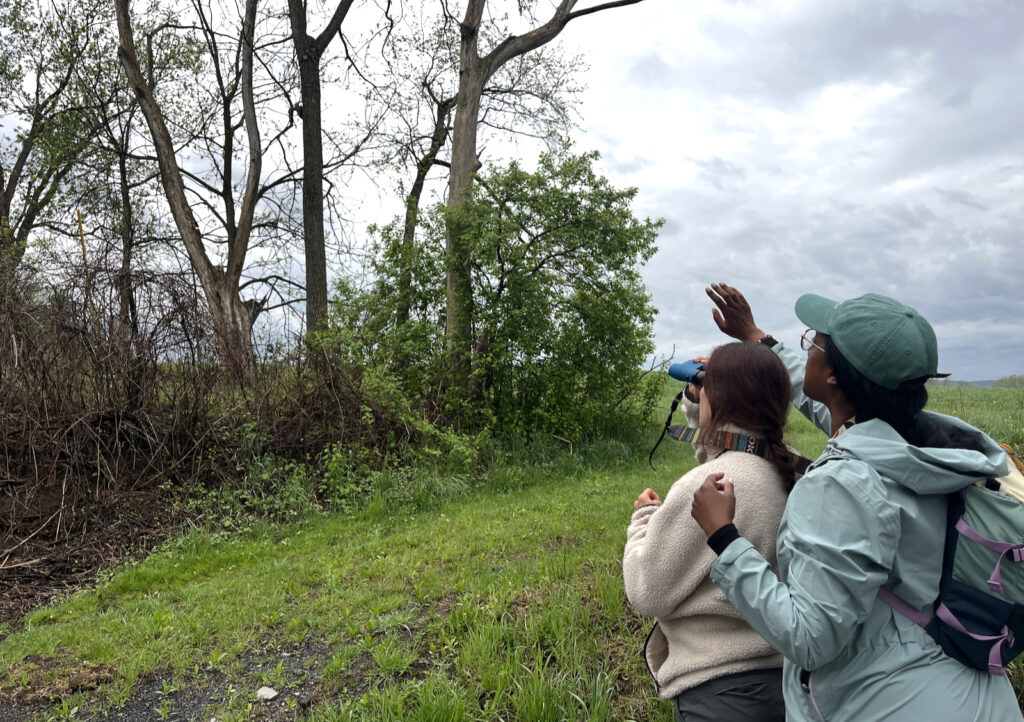
We lingered a bit longer at Rhoneymeade before loading into Jen’s Honda Fit and driving down the road to the Black Hawk Quarry, where we scrambled up to find a view where we could scan the rough and rocky landscape, hopeful for a sighting of habitat-specific Bank Swallows, scouted by Jen the week before. Indeed, after a minute or two, we heard their twittering chatter and helped each other find the birds in our binoculars as their dark gray bodies darted and zig-zagged, blending in against the background of exposed rock.
From the quarry, we beelined to Chicory Lane Farm in Spring Mills, cousin to Rhoneymeade in that both properties are conservation easements managed with careful consideration for the ecological health and perpetuity of the flora and fauna who inhabit the land. Rain drops began falling as we arrived around 8:30 a.m., but we were not dismayed! We were greeted by gracious landowners, Mr. and Mrs. Smith. We donned our rain gear and began a slow and squishy walk through the water-soaked, ambling grass paths of the wetlands, puzzling over several shorebirds flitting between the ponds and eventually determining that they were all the same—several Solitary Sandpipers.
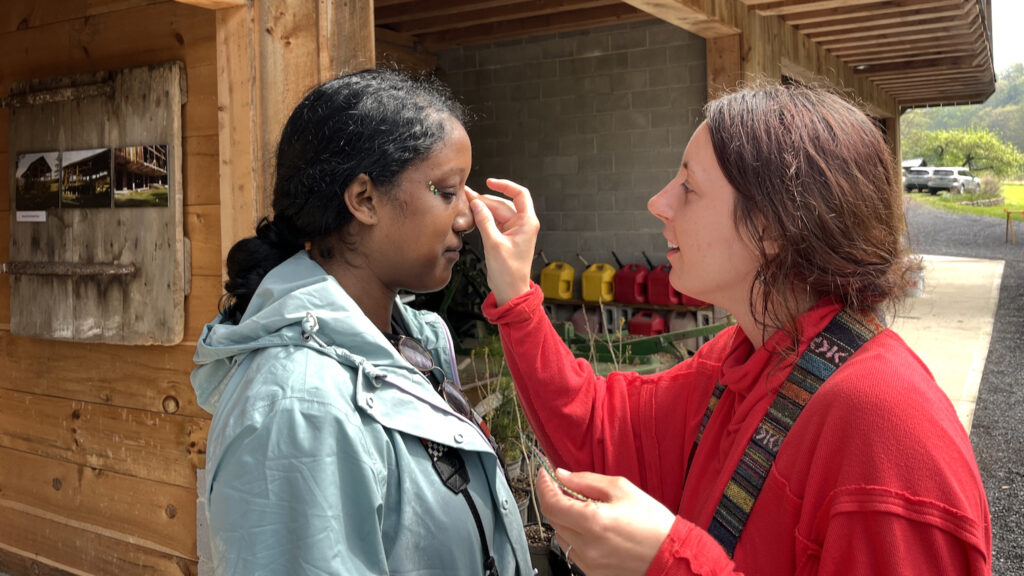
Birdsong was relatively quiet (except the Swamp Sparrow that we happily spotted and checked off!) As we continued, most of the birds seemed to have sought cover to avoid becoming as drenched as we were. We finished our loop around 10:30 a.m. and were delighted to feel the sun breaking through the clouds, prompting us to eagerly shed our rain gear and lay it out to take advantage of any possible drying power. At this point, we also paused to eat some delicious lemon basil pasta and other treats Autumn had found at Trader Joe’s, and we decorated our faces with tiny bejeweled stickers. I’ve learned during my ten years as a Birding Cup participant that it’s important to find small things to lift morale over the 24 hours!
From Chicory Lane, we headed toward Colyer Lake, stopping at Muddy Paws Marsh (noting a pair of Coots and a Green Heron!) and then driving along Sinking Creek in an effort to stay as close to where the birds might be and as far from busily trafficked Route 45. Upon arrival at Colyer Lake, we were excited to see a team of fellow Shaver’s Creek colleagues in the parking lot. We shared hugs and brief highlights before turning our attention to the lake. With kind guidance from our “rivals,” we sighted a Spotted Sandpiper as well as one of the birds Jas was most hopeful to see—the Double-Crested Cormorant!
Around 1:00 p.m., we took our leave of the lake and drove back to Rhoneymeade, saying farewell to Autumn who headed back to Shaver’s Creek to assist with set-up for the closing ceremony of the competition. Jas, Jen, and I sprawled on a trailer bed near the barn, eating soup and snacks in the company of one very friendly and curious rooster. As a birder, I’ve deeply enjoyed training my ears to be constantly filtering the surrounding environment both passively and actively for the songs of feathered creatures, and as we ate, my senses suddenly tuned in to a jumbled song in the tree near us. I turned to Jen and Jas and tentatively said, “I think I’m hearing a Bobolink.” We focused our attention, walking toward and around the tree until the black and white bird with a beige patch on its head came into view, and I soaked in its presence, as it was one of the birds I was most hopeful to see and hear. I love seeing these birds, which are found in specific grassland habitats but are not overly abundant in central Pennsylvania.
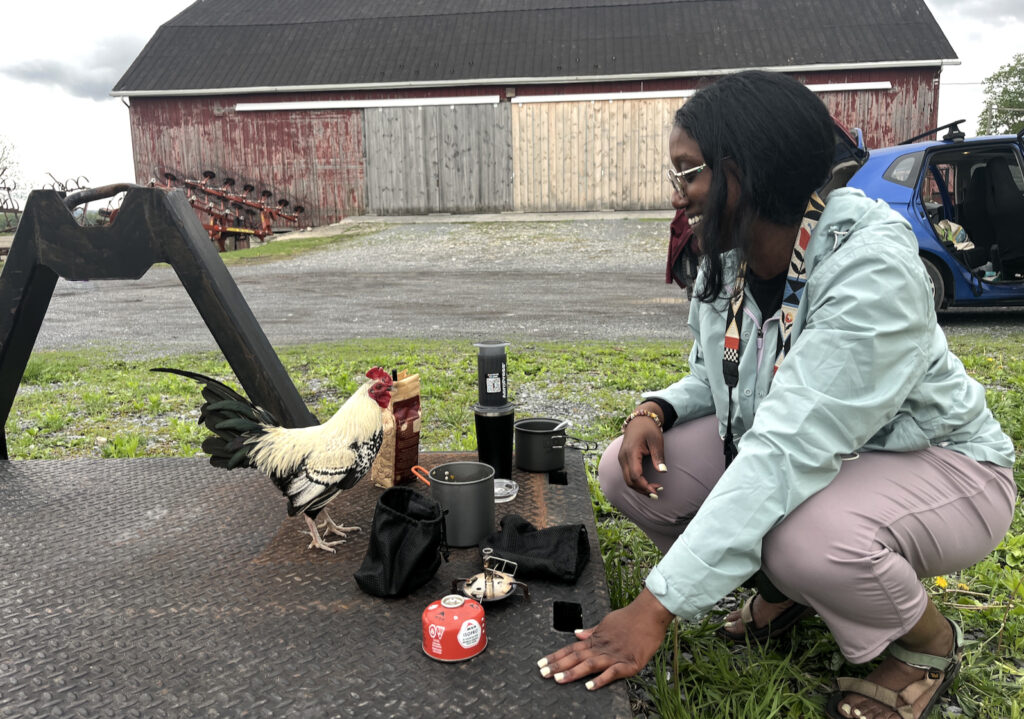
After identifying the Bobolink, we chose to return to the trailer bed to finish our soup and snacks before getting back on the road to look for more birds. Around 2:30 p.m., we loaded back into Jen’s car and headed into Rothrock State Forest to see what other birds we could find. We traveled along Bubb Road for a while, slowly driving with our windows down, hoping to hear bird songs through the sounds of the wind and road.
Jasmine: I am a fairly new birder and am constantly adding birds I see (and identify) in the wild to my life list. The part of the Birding Cup I was most excited about was seeing birds in the wild that I have never seen before, during the longest amount of time I have spent birding in a 24-hour period. Earlier in the competition, I had mentioned never seeing a hummingbird in the wild. We passed through some slightly residential areas of Rothrock and noticed a property with a hummingbird feeder in the yard. We waited eagerly, hoping to see one, but it was not to be.
After a while of no activity at the feeders, we decided to drive deeper into the forest. We approached a gravel road intersection and Jen began to slow the car down so we could listen and look from our windows. As Jen reached down to grab her binoculars, we heard a loud buzzing sound approaching the car. Naturally, I thought it to be some sort of insect. To our surprise, a Ruby-Throated Hummingbird flew up to the driver’s seat window! We all excitedly admired the bird, shocked that it had come so close to the car and that it was hanging out in this very wooded habitat.
We continued along the gravel roads of the forest. We would drive slowly on the road, often stopping for a few minutes, turning the car off, and sometimes even getting out to look around and listen. In this way, we spotted a Raven’s nest (complete with Raven), heard Ruby-Crowned Kinglets and a number of warblers—Worm-Eating, Black-and-White, Tennessee, Hooded, and Cape May among them. Around 6:00 p.m., we were birding from the car windows, driving slowly down Crowfield Road. I was scanning the branches, hoping to see something that stood out in the landscape. To my delight, I spotted a Barred Owl, perched on a tree. It was the first owl we had seen all day and the first time I had seen a Barred Owl in the wild. We all shared the joy of being able to see this beautiful and majestic animal.
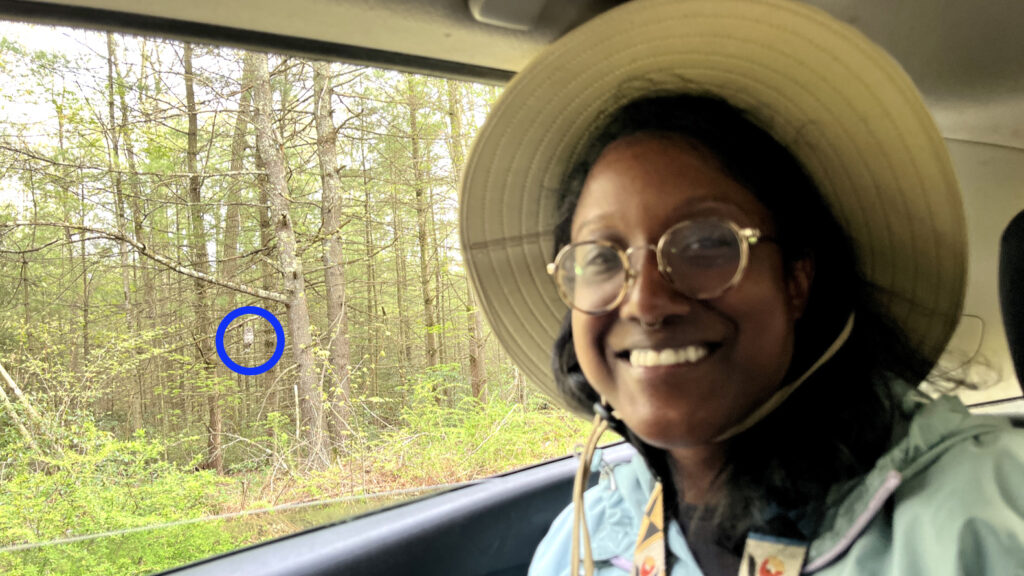
Note from Jen: At some point in our backwoods driving, we had gotten out of the car and I wandered into the woods away from the group to “take in the view,” and while I was out there, I heard a Ruffed Grouse drumming! I collected myself and ran back to the group to ask if they had heard it, but they had not, so we couldn’t count it on our checklist because the rules state that “any bird tallied must be seen and/or heard and identity agreed upon by at least 3/4 of the team members.” Bummer!
We stopped our count at 7:00 p.m. (as instructed by the rules of the competition) and headed over the mountain to Shaver’s Creek for the closing celebration. Welcomed warmly by Shaver’s Creek staff and volunteers, we received our participant t-shirts, handed in the finalized checklist of the 97 species we had tallied, and had our team photo taken. We joined in the celebration in the Hamer Classroom: food, beverages, and lots of happy birders sharing stories of birds they saw and birds that evaded them.
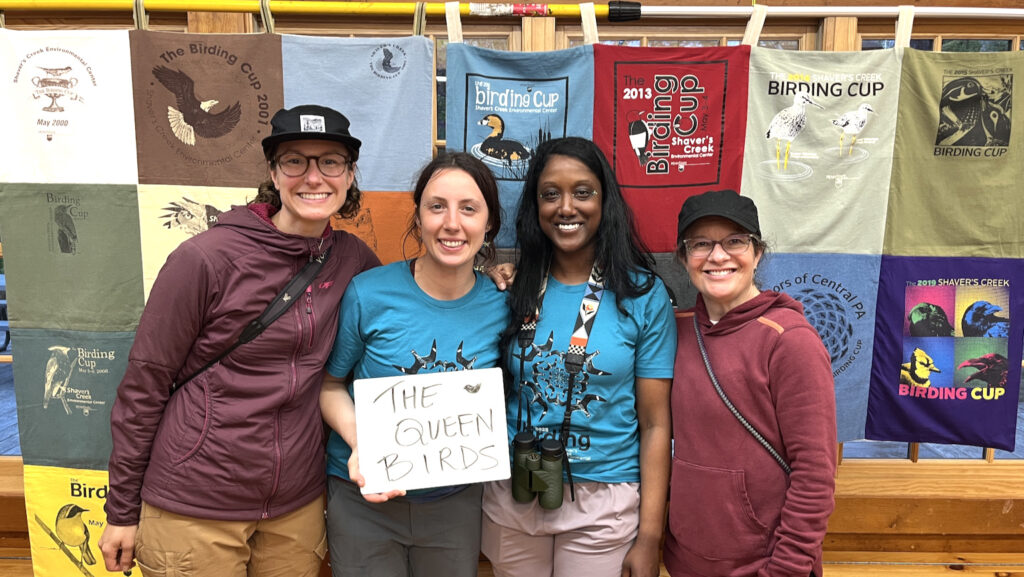
The formal ceremony includes a reading of the checklist to compile how many species were seen by all the teams (a whopping 185 species!) and celebrate the winners in each of the competition categories. While we didn’t win any prizes, we appreciated the time spent celebrating beautiful places with beautiful people and birds, feeling grateful for the experience. We parted ways with exhausted hugs and ideas for future adventures!