

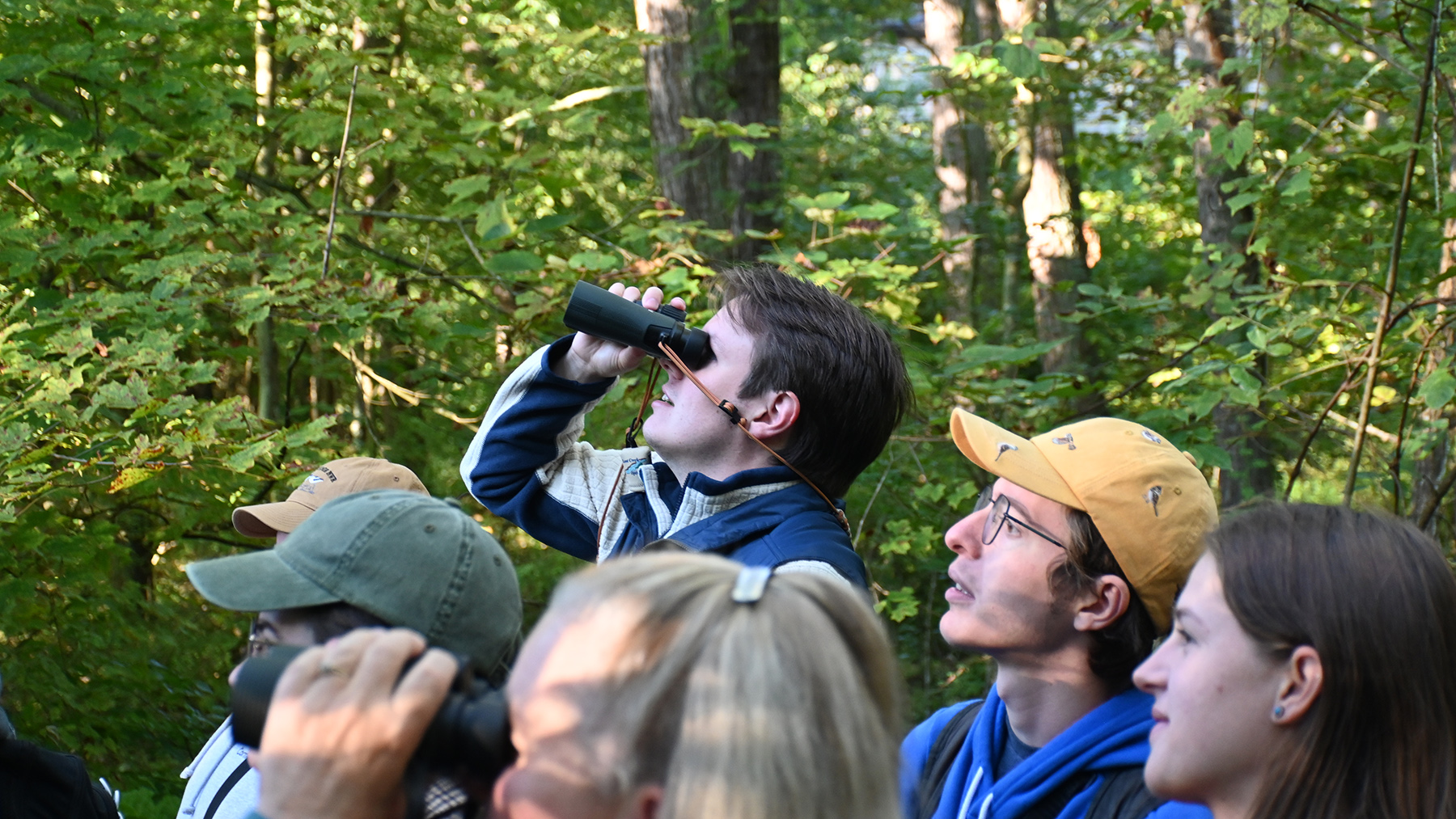
We spend our lives noticing things. Most often, these observations are fleeting—we acknowledge or respond to them, then they are gone. “The light is red, I need to stop my car,” or “it is cold outside, I should warm up.”
Sometimes, those observations are memorable enough that we ascribe meaning to them, we associate them with something. I remember, as a kid, spending my summer days outside, and the sounds of Canada Geese flying overhead would signal that summer was nearing its end and school was beginning soon. And the redbud tree in our front yard, which was a great climbing tree, would blossom beautiful pink petals, but only for a little while in the spring.
Looking back, I realize that some of my earliest memories of noticing the natural world happened to be the changing of the seasons, especially the transitional seasons of spring and fall. They have continued to be some of my favorite times of the year, and I find myself drawn to learning about and appreciating the local phenology.
My observations have grown more intentional in the past five years—which coincidentally lines up with when I began working at Shaver’s Creek—and I have taken to recording them. I’ve written and drawn in nature journals, made checklists of flora and fauna, and filled my camera gallery to the brim with pictures of nature (a search for “plant” in my phone’s gallery yielded 2,781 photos). This has been one of my favorite methods of tracking the changes in the seasons, and it can provide a lot of information. Taking a picture of a flower in spring gives me a rough range in time for when that flower blooms. Photographing the sunset over multiple days in the fall shows the daylight getting shorter and shorter as the timestamps get earlier and earlier.
Through my observations over the years, I have come to know Shaver’s Creek and the surrounding woods, meadows, and marshes. My hope is that throughout our 50th year, I will be able to share some of my observations of the Shaver’s Creek phenology, share a little bit about the work that goes on during these seasons, and inspire you to make your own observations about the natural world around you, wherever you are.
I grew up with the saying, “March comes in like a lion and out like a lamb”—the lion being the cold and harshness of winter, the lamb the calmness of spring. There is some truth to this phrase, the spring equinox occurs in March, ushering in the new season. However, I have seen Marches that came in like a lion and out like a lion; Marches that came in like a lion and out like a rambunctious sheep; and Marches that came in like a lion, out like a lamb, only for the lion to return two weeks later in the middle of April, covering all of the wildflowers (that I was going to lead a program about) in snow.
All this to say, I have come to view March as an overture to spring. Overtures in music introduce the themes and motifs that will be present throughout the piece. They’re usually only small snippets of the whole, but they give an idea of what you are in store for. In the same way, March introduces us to some of the key features of spring: flowers blooming, birds migrating, and animals becoming more active, as nature is waking up from a restful winter.
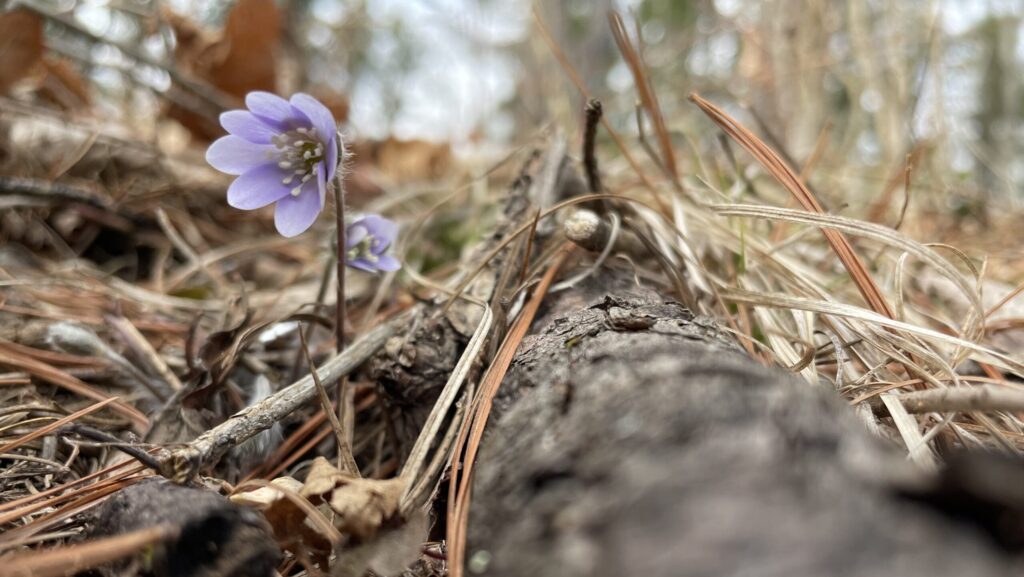
Each March, one of the first flowers that I have pictures of in bloom is round-lobed hepatica (Hepatica americana). This hepatica usually has lavender flowers, although sometimes they are white or a darker purple, and has leaves with three rounded lobes. I have found hepatica at Shaver’s Creek along the Point Trail, just after the public restrooms, where the ground slopes down to Lake Perez. I remember finding this small patch of hepatica while being serenaded by a symphony of spring peepers.
Spring peepers (Pseudacris crucifer) are small tree frogs with brown, grey, or tan skin. They can be difficult to see, but they sure are easy to hear. In fact, it would be more difficult to not hear spring peepers in March, especially if you find yourself near water. They are most active in the afternoon through the evening and into the night. Sometimes you wonder why things in nature are named the way they are. That is not so with spring peepers. They are most active and vocal in spring, and their call is a high-pitched “peep” repeated once a second. Groups of males will gather in and around wetlands and call to attract mates, and the results can be deafening.
I would be remiss in talking about early spring flowers if I didn’t mention skunk cabbage (Symplocarpus foetidus). Skunk cabbage is identified by its purple-and-green mottled spathe (a modified leaf that protects the spadix, or flower cluster, inside of it), and it is another of those things that are aptly named. Its odor is often compared to rotting meat, garlic, and skunk spray all in one. This smell attracts beetles and flies to assist with pollination. By late spring, the large, green, cabbage-like leaves have begun to grow, and can be seen throughout the summer. Despite being called cabbage, it is not recommended to eat.
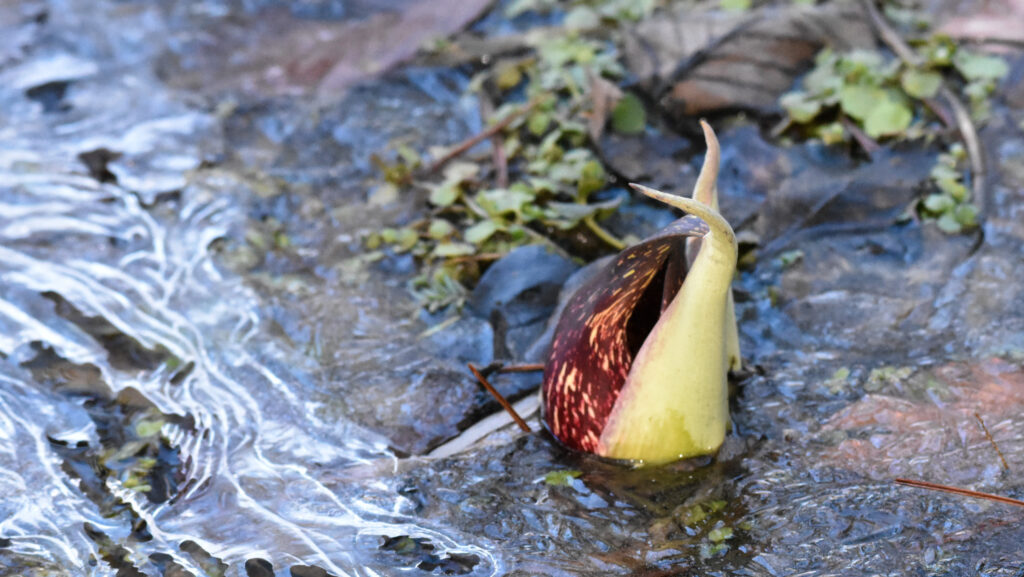
The thing that makes skunk cabbage flowers synonymous with early spring is their ability to grow even when there is still snow on the ground. Skunk cabbage performs a process called thermogenesis, in which they produce their own heat to melt any snow and ice. Skunk cabbage is often found in marshy areas, and the best place to find it around Shaver’s Creek is down by the Boardwalk.
While you’re down by the Boardwalk looking for skunk cabbage, you may see a small, grey bird flying around. If you take some time to observe this bird, you may notice that it has hints of yellow along its sides and a really dark head. You may see this bird perch on a branch, fly out over the water for a few seconds to catch a fly, then return to its original perch, twitching its tail as it perches. You may even be lucky enough to hear the bird sing: “FEE-bee, FEE-bee.” If you have noticed all of these things, then congratulations! You have just encountered an Eastern Phoebe (Sayornis phoebe)! The Eastern Phoebe is what I call a ‘say-your-name’ bird, in that they say their name, well most of their name, at least.
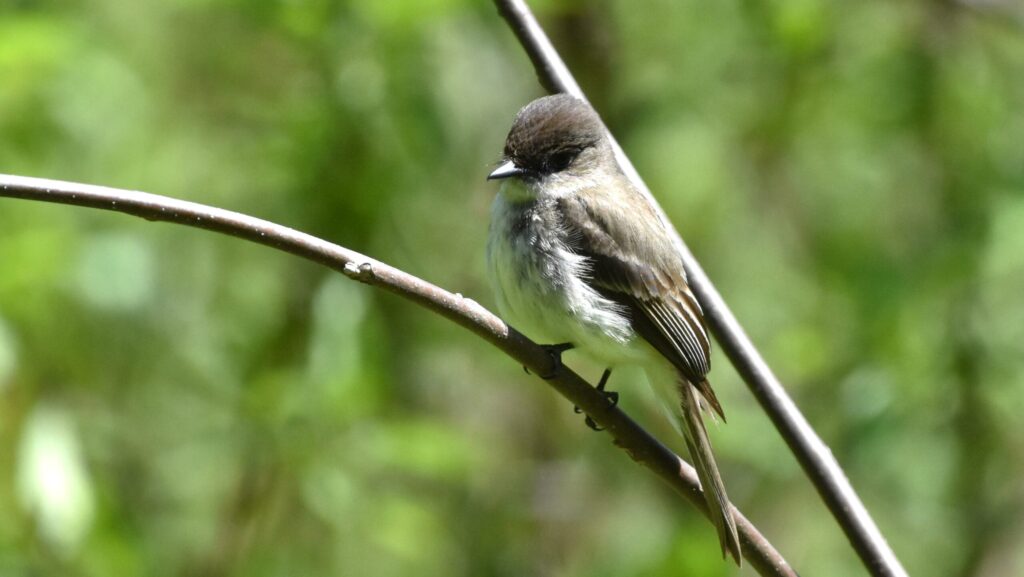
When I think of migrating birds, I think of the Eastern Phoebe. Not because they have one of the longest migratory treks, but because, around Shaver’s Creek, they are one of the first migratory birds to return in the spring and one of the last to leave in the fall. They are even known to return to their same nesting sites year after year.
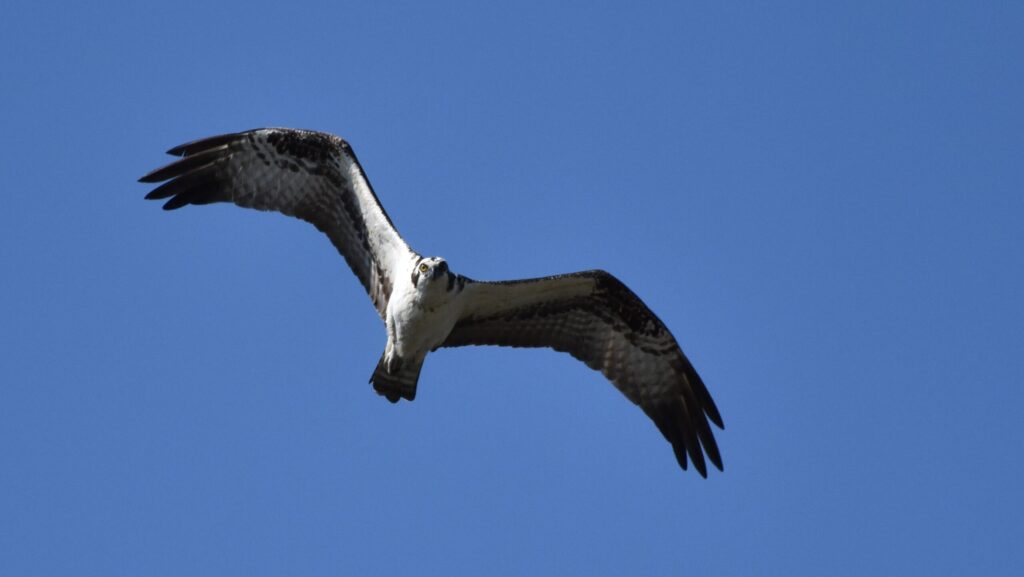
Another bird you could encounter while on the Boardwalk is an Osprey. Ospreys are solely fish-hunting birds of prey, and as a result, must migrate to where they can hunt fish. When the lakes and rivers start to unfreeze, and the fish populations begin to breed, that is when the Osprey returns. You can hear their clear, high-pitched chirping as they soar above lakes or perch in trees above moving water. At Shaver’s Creek, I have noticed that the Ospreys tend to return right around the time of our Maple Harvest Festival weekend, occurring in late March. A number of years, I have had my first-of-the-year Osprey as I was walking from Stone Valley over to Shaver’s Creek to help out with the Maple Harvest Festival.
Like the flowers blooming, the frogs emerging, and the birds returning, Shaver’s Creek itself is following suit and preparing for spring programming. Our largest program of the year is the Maple Harvest Festival, which happens at the end of each March. Beginning in 1984, the festival draws visitors from the local community, but also the larger network of Shaver’s Creek alumni and volunteers from across the country.
And in March, the preparation at the Center is in full swing. The interns have been collecting sap from the trees they tapped and boiling it down in the Sugar Shack. They have been recruiting the 100+ volunteers and staff that it takes to run the festival, and have been ordering food and coordinating so many other logistics to feed the more than 2,000 visitors that we have during the weekend. One of my favorite sounds has to be the dripping of sap into metal buckets.
Shortly after the Maple Harvest Festival, the spring season of Outdoor School begins! Outdoor School is Shaver’s Creek’s four-day residential camp for upper elementary school students. Outdoor School offers students positive, outdoor experiences and hands-on activities to help them experience and learn about the natural world. The hope is that students come away from their week with an understanding of how to live healthy and harmonious relationships with other people and the earth.
But who facilitates these positive outdoor experiences and hands-on activities? We have a team of Shaver’s Creek staff that have been working hard to plan out lessons, create materials, and recruit Penn State students to be both counselors and learning group leaders. The counselors and learning group leaders have been taught through classes and trainings on how to lead students, how to teach the different lessons, and how to do a myriad of other things that can arise when you have elementary school students staying at a camp overnight, maybe for their first time. Outdoor School has proven to be such an impactful experience for all students, elementary- and college-aged alike.
When migrating birds return to the area in the spring, they are often sporting bright new breeding plumages. Shaver’s Creek is also emerging from the winter looking its best. Our Grounds and Facilities crew uses the winter season to rejuvenate the Center, getting it ready for summer visitors. They do deep cleaning of our floors and work hard to maintain the trails, especially given all the snow we had over this past winter, and so many other projects that keep the Center going and make it look beautiful.
As I sit atop the hill, with hepatica at my feet and the sound of spring peepers in my ears, having ventured outside without need of a coat, I take a deep breath. The cool air fills my lungs, and with it, a buzz of anticipation. A buzz of a natural world that has been at rest under cover of snow for months and is about to burst with color and sound and excitement. I have listened to the overture of spring, and noticed the changes happening around me. And my hope is that you, too, will take some time to notice the world around you, in whatever form that may take.