

During the late summer, after I had officially joined Shaver’s Creek as an environmental education intern, the first area that I became accustomed to was Lake Perez. More specifically, I saw a lot of Lake Perez from the boardwalk that exists as part of the Lake Trail. And while the water itself was beautiful, what I enjoyed seeing the most were the plants that hugged the sides of this trail. There were so many colors and sizes and types of plants that one could easily become overwhelmed looking at them all. Each one, although different looking, plays such a fascinating role in the ecosystem. Wetland habitats themselves feel so incredibly unique from other habitats that exist. One does not need to know much about wetlands to see that they have a variety of organisms within them. The sheer number of pictures I have of the different plants from this one portion of Shaver’s Creek amazes me. Wetlands are incredibly important and beneficial because of this biodiversity. Alongside their high biodiversity, wetlands also help with groundwater replenishment, water filtration and purification, as well as nutrient retention, all of which are aided by the plant and animal organisms that rely on these systems. These habitats have been considered one of the most productive as they actively sequester emissions and help with naturally combating climate change. However, they can also serve as emission releasers when they transition from aquatic to terrestrial land, a process either hindered or exacerbated by climate change.
As wetlands are immensely beneficial and are quite susceptible to climate change, it is one of the habitats I felt most called to highlight. The four “ambassador” plants for this habitat were not necessarily chosen for their specific ecological importances, but moreso for my belief in their uniqueness, which demonstrates the rich biodiversity of these areas. Hopefully you can see for yourself how truly magnificent this habitat can be!
Watershield (Brasenia schreberi)
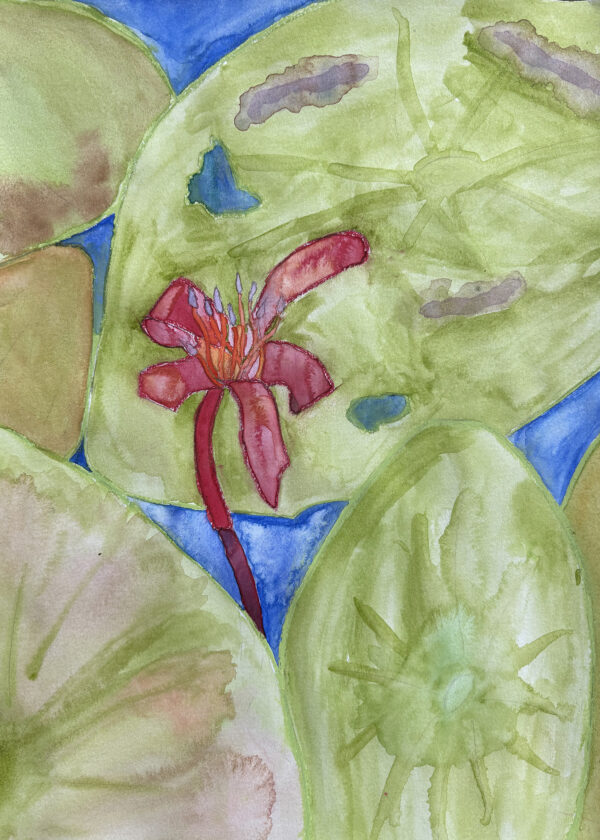
There is nothing quite like kayaking on Lake Perez in the late summer sun, running your fingers through the water and feeling the slimy stems of these plentiful plants. The oozy texture was like a sensory train wreck; I hated the experience but could not stop touching it. These slimy plants are called watershields, as they look like small oval-shaped shields. Watershields have these long stems that connect the floating leaves to their roots at the bottom of the lakebed. Underwater parts of plants are covered in a mucus substance that scientists have argued exists to protect the plant from potential drought, act as defense for younger plants, stop water from entering the tissues, and/or deter herbaceous organisms from eating it. In Japan and China, these slippery shoots are harvested in the summertime and form the delicacy known as Junsai, which has a long history in both regions. Besides the plant’s interesting protection method, watershields also have a fascinating reproduction cycle. This cycle occurs over the course of two days. On the first day, pistils emerge from the water, stretch out, and then are brought back underwater at night. On the last day, the flower once again emerges, this time with the stamen, which lengthens upward. At the end of the day, the flower is submerged and the fruit forms underwater.
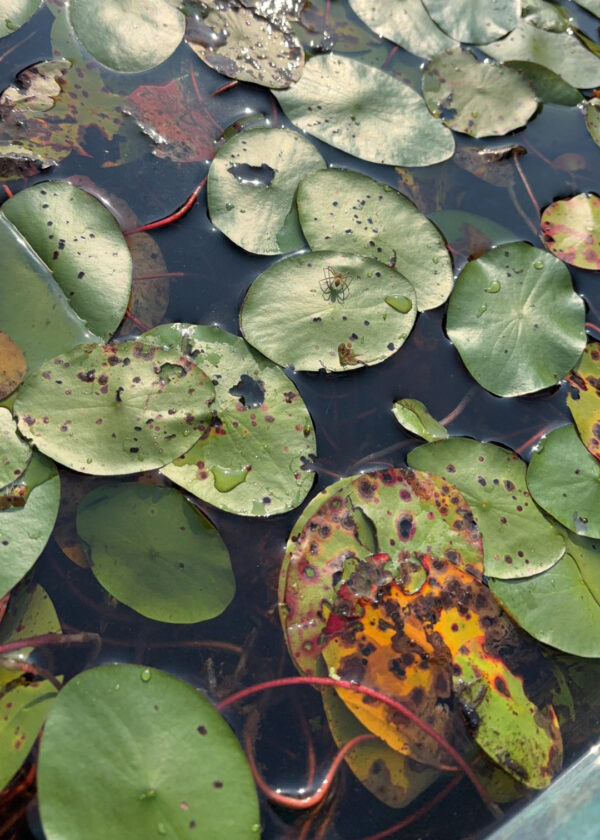
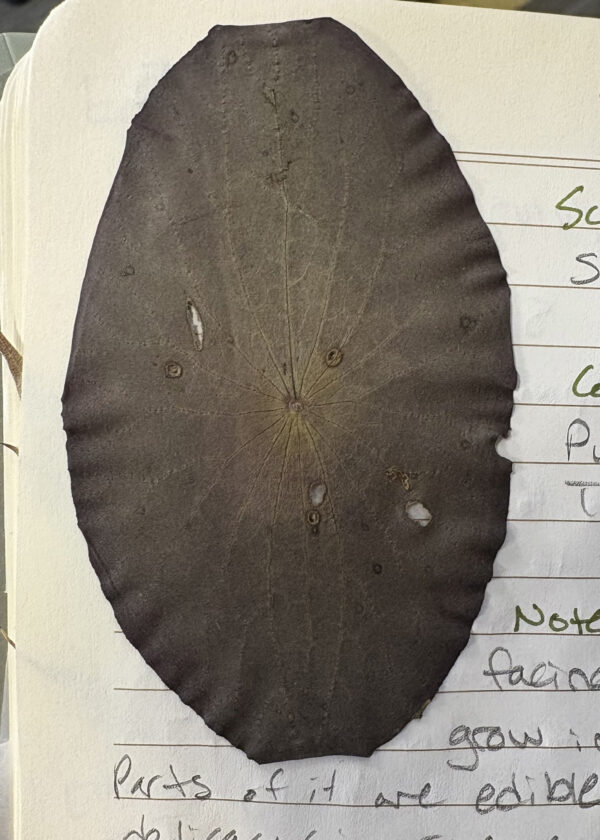
Watershield is the only plant in this blog that I have a pressing of in my own nature journal! This leaf was floating without a connecting stem, so I took it and allowed it to dry out a bit before pressing it. Amazingly, for an aquatic plant, it flattened out quite nicely. It has a soft, leathery feel to it. I find it interesting that it dried out to a grayish purple instead of holding on to its bright green like other leaves do when they are dried and pressed. I wonder if that difference is partially due to it being an aquatic organism or if I had it drying out for too long before pressing it. Watershield definitely brings out a lot of curiosity within me, which makes wanting to depict it artistically that much more enticing.
Seedbox (Ludwigia alternifolia)
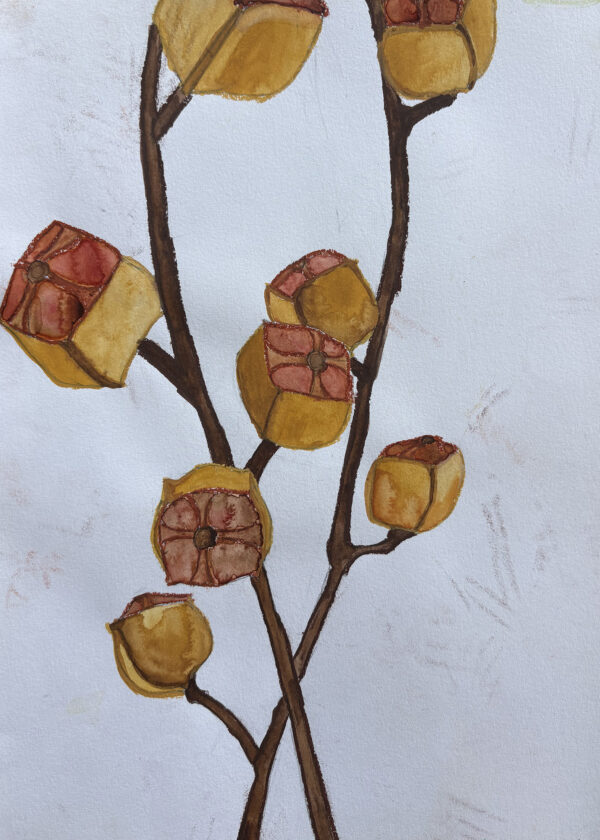
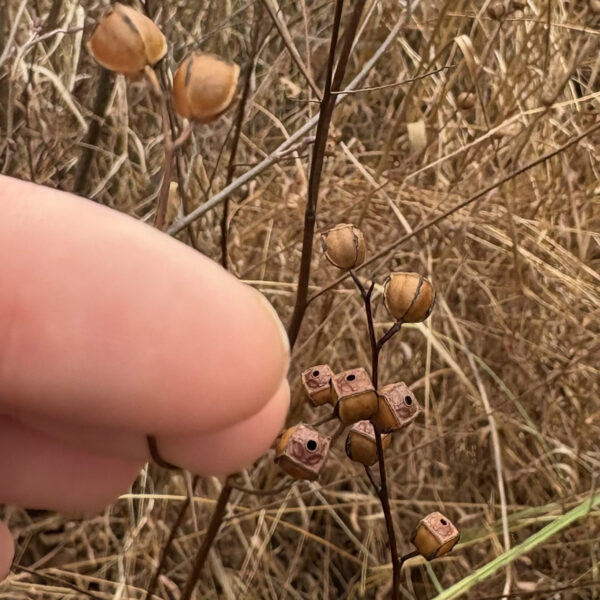 Speaking of plants that spark my curiosity, seedbox is one such plant that I immediately wanted to find, once I learned of its existence. I first learned about seedbox after seeing a picture of it on iNaturalist. I have never witnessed such a square-looking plant before. The “squares” I am referring to are the “seedboxes” for which this plant is named. Seedbox is a summer plant and it flowers in late June. As the plants first flower, they have four bright yellow petals, which are typically dropped the day they arrive. Following the yellow petals, four green or red-tinged sepals take the petals’ place. These sepals stick around for two to three months. After August, the sepals start to fold up and harden, creating the dull-brown boxed fruit that dot the stem. Within these boxes, around 200 to 2,000 tiny seeds reside. The seeds are released through a circular hole at the top of the box. The fruit stays all throughout winter, and if you find one and give it a shake, you can hear the seeds rattling inside. Besides its unique shape, seedbox does not have any unique properties and it is mostly used by bees for pollination and some beetles for eating.
Common Jewelweed (Impatiens capensis)
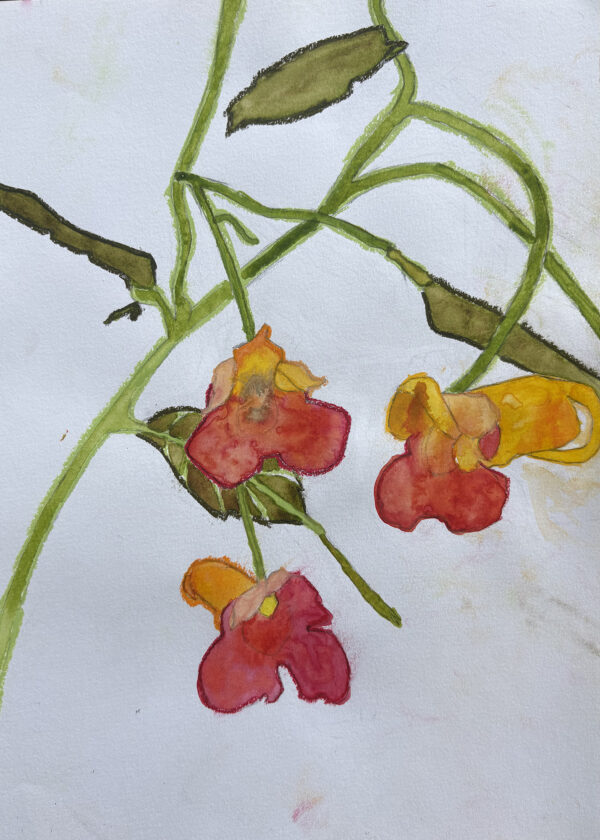
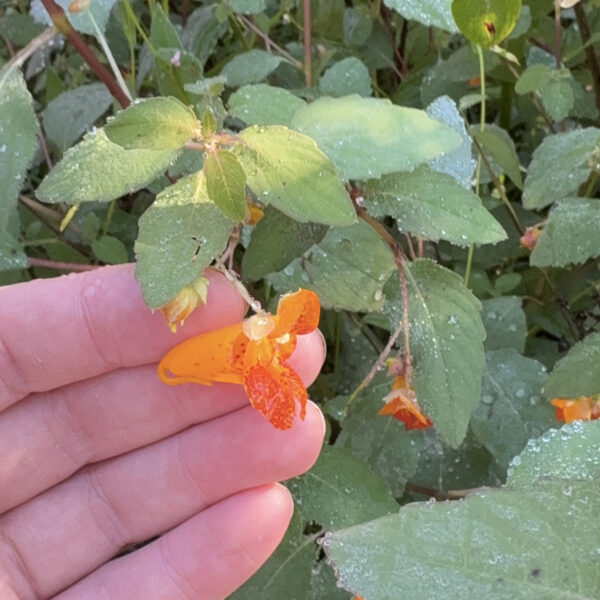 Jewelweeds are very captivating wildflowers for a variety of reasons. One of those reasons is how it is an annual, meaning it only survives if its seeds survive, which is quite different than the perennials that I have highlighted thus far. Growing from that reason, this family of plants has a strange reproduction manner so that there is a better change of seed production. Jewelweeds have two flowers, one open and one closed. The open flowers have a similar reproduction manner to watershields in that its female and male parts exist at different times to ensure cross-fertilization. The closed flowers are entirely self-pollinated and tend to be the breadwinners when it comes to seed-making. These two flowers rely on touch or wind to disperse their seeds. The open flower will shoot the seeds further away, while the closed flower will shoot them closer to the parent plant. The plant is so finicky that a slight touch allows one to see the seeds exploding outwards. If someone cups their hand around the flower, they could collect the seeds, which have been known to make tasty snacks. Most parts of the plant are edible and have been used by a plethora of Indigenous and non-Indigenous groups to cure a multitude of illnesses and rashes. Another fascinating feature of jewelweed is that they have waterproof leaves. If you were to dunk a leaf into water, it would come out dry, which is something I would love to witness. The main pollinators of this plant are ruby-throated hummingbirds. Jewelweeds have been hailed for their high nectar amount and their importance in fueling these birds during the summer months.
Broadleaf Arrowhead (Sagittaria latifolia)
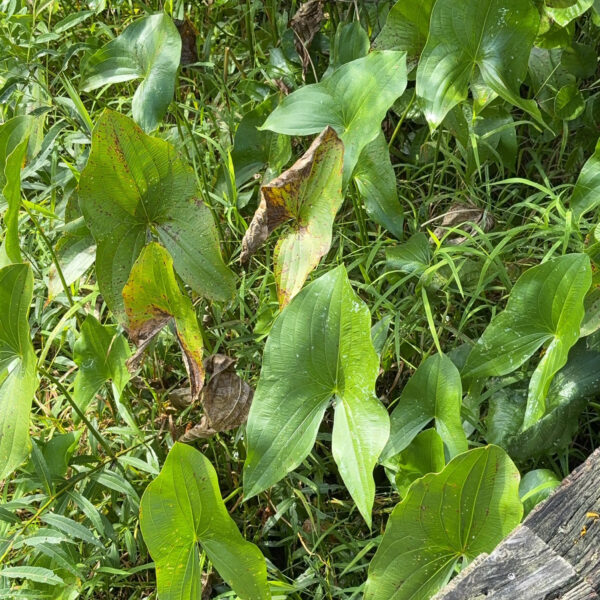 Broadleaf arrowhead is considered one of the most common wetland plants in eastern North America, however, this past summer was the first time I took notice of this interestingly shaped plant. Arrowhead has been labeled a “true amphibian among plants,” for its ability to grow in submerged aquatic habitats as well as drier soil. The arrowhead at Shaver’s Creek can be spotted sticking out of the water on either side of the Boardwalk. In the summer, one could spy rows of three three-petaled white flowers climbing up some of the stems of the arrowhead. These flowers then turn into ball-like fruits. What I find the most intriguing about arrowheads, however, are the tubers that grow at the base of the root. These tubers have been labeled duck potatoes, and they have a rich connection with waterfowl and Indigenous communities. “Duck potato” comes from the fact that many waterfowl, including several species of duck, have come to love eating these fibrous bulbs. Not only do waterfowl take advantage of this food source, but muskrats, beavers, and porcupines have been stated to dabble in them as well. It has been documented that, historically, certain Indigenous tribes and nations, such as the Meskwaki and the Forest County Potawatomi community, would even take duck potatoes from caches created by mammals. Throughout many Indigenous cultures, this plant either acted as a food source, was used in medicine, or in some cases was utilized in gambling. Even with its heavy tuber usage, arrowhead has also been considered a nuisance in that it transpires a heavy amount of water, so much so that dense patches of it can drain temporary pools in the summer. At first glance, at least to me, arrowhead felt very simple, but seeing its unique properties and diverse uses has caused me to view this plant a bit differently.
My Artistic Depictions
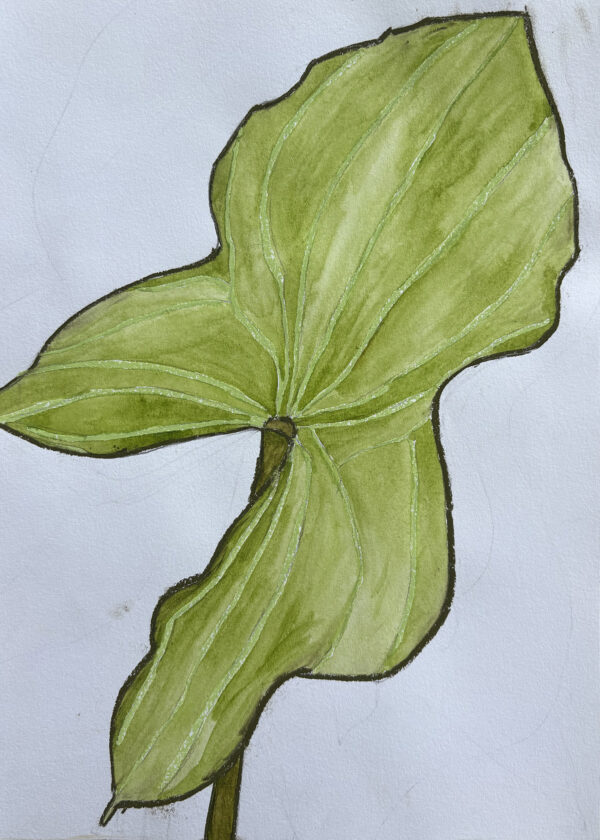
For this blog, I wanted to get out of my comfort zone when it came to my own depictions of the plants in this beautiful habitat. I used two mediums I have never worked with previously: pastels and watercolors. I began with messing about on sketch paper with both styles, seeing if I liked one over the other or if they could be used in tandem with each other. I ended up enjoying the contrasting textures and colors and decided to use both. The pastels make up the darker, chalkier outlines while the watercolors are the filler. Together, they make a kind of messy and hard-to-work-with creation, but I would not have it any other way. While the pastels were my favorite artform to use, the watercolors hold a special place in my heart as the water I used was taken directly from Lake Perez. Even in drawing format, the plants get to thrive in the same water their depicted selves continue to utilize.
References
Castetter, Edward Franklin. Yuman Indian Agriculture: Primitive Subsistence on the Lower Colorado and Gila Rivers. University of New Mexico Press, 1951.
Duenas, Manuel. “Sagittaria latifolia (broadleaf arrowhead).” CABI Compendium, last updated April 9, 2010, https://www.cabidigitallibrary.org/doi/10.1079/cabicompendium.109160.
Eastman, John. Swamp and Bog: Trees, Shrubs, and Wildflowers of Eastern Freshwater Wetlands. Stackpole Books, 1995.
“Jewelweed,” Native American Ethnobotany Database, accessed December 10, 2025, http://naeb.brit.org/uses/search/?string=jewelweed.
Jisha, K.C. and Jos Puthur. “Ecological Importance of Wetland Systems.” In Wetlands Conservation: Current Challenges and Future Strategies, edited by Sanjeev Sharma and Pardeep Singh. Wiley‐Blackwell, 2022.
“Ludwigia alternifolia,” Missouri Botanical Gardens, accessed December 10, 2025, https://www.missouribotanicalgarden.org/PlantFinder/PlantFinderDetails.aspx?kempercode=e113.
Martin, Laura. A Naturalist’s Book of Wildflowers. Countryman Press, 2021.
Ott, James. “The Biology of Acanthoscelides Alboscutellatus (Coleoptera: Bruchidae) on its Hostplant, Ludwigia Alternifolia (L.) (Onagraceae).” Proceedings of the Entomological Society of Washington 93, no. 3 (1991): 641-651.
Salimi, Shokoufeh, Suhad Almuktar, and Miklas Scholz. “Impact of climate change on wetland ecosystems: A critical review of experimental wetlands.” Journal of Environmental Management 286, no. 1 (2021): 1-15.
Sanders, Jack. Hedgemaids and Fairy Candles: The Lives and Lore of North American Wildflowers. Ragged Mountain Press, 1993.
Sharp, Shannon. “Plant of the Week: Watershield (Brasenia schreberi).” United States Department of Agriculture and U.S. Forest Service. Accessed December 9, 2025. https://www.fs.usda.gov/wildflowers/plant-of-the-week/brasenia_schreberi.shtml.
Smith, Huron. “Ethnobotany of the Meskwaki Indians.” Bulletin of the Public Museum of the City of Milwaukee 4, no. 2 (1928): 175-326.
——— “Ethnobotany of the Forest Potawatomi Indians.” Bulletin of the Public Museum of the City of Milwaukee 7, no. 1 (1933): 1-230.
Thompson, K.A., D.M. Sora, K.S. Cross, J.M. St. Germain, and K. Cottenie. “Mucilage reduces leaf herbivory in Schreber’s watershield, Brasenia schreberi J.F. Gmel. (Cabombaceae).” Botany 92, no. 1 (2014): 412-416.
Yokoyama, Wally, James Pan, and Hyunsook Kim. “Culinary History and Health Benefits of Brasenia Schreberi Leaf and Hydrocolloids.” In Washoku, Japanese Food, edited by Masuko Kobori, Hiroshi Nabetani, Wallace Yokoyama, and LinShu Liu. ACS Publications, 2022.