

Back in March, I wrote a blog post about noticing nature around us. In it, I mentioned that the transitional seasons of spring and fall are some of my favorite times of the year, especially when it comes to phenology. I went on to detail some of my own observations about the coming spring, like migrating birds and blooming flowers.
September is a part of that other transitional season—autumn. (Only part of September, though. The autumnal equinox occurs toward the later part of the month, meaning most of September is still summer.)
In my opinion, September in Pennsylvania has some of the most perfect weather known to exist. You get sunny days with blue skies, where the temperature can be in the high-80s, or you get sunny days with blue skies, where the temperature can be in the mid-60s. Or you could get really overcast days where it rains without end and you get the first notes of winter (but that’s still a few months off). You have lots of daylight to spend outside amongst the cooling breeze, but you start to notice the days growing shorter.
Something that I think gets overlooked in September are the flowers that bloom. Spring always seems to be the season that comes to mind when you think of flowers blooming, but I believe that September could give spring a run for its money when it comes to blooming flowers. This is in no one way, however, downplaying the beauty of spring wildflowers—my favorite flower, the yellow trout lily, blooms in spring, so I get it.
A great place to see some of these late-summer, early-fall blooms is along the Boardwalk Trail at Shaver’s Creek. I set out on this walk to see if I could find a flower or plant for each color of the rainbow during the month of September, and I am proud to say that I was able to do this just in one walk.
For red, my eyes were drawn to the bright red berries of Jack-in-the-pulpit. A native wildflower, the mature female flowers produce a cluster of bright red berries that can be seen in autumn. Another red that can catch your eye is that of cardinal flower, a plant that can be seen growing near wet areas (like the Boardwalk), can grow a couple feet tall, and boasts showy red flowers.
Cardinal flower is a favorite of Ruby-throated Hummingbirds, who are getting as much food and fuel as they can before beginning their lofty journeys southward. Ruby-throated Hummingbirds will travel between 1,500 and 3,000 miles south to their over-wintering grounds in Central America. Hummingbird sightings are still possible in September, though they quickly dwindle as the month goes on. From the Boardwalk, I watched one feed on cardinal flowers then traverse a 30-yard stretch of open lake, which pales in comparison to the nearly 500 miles nonstop that some choose to fly over the Gulf of Mexico. Others may take a longer, more coastal route around it. Either way, hummingbirds need a lot of fuel to make this journey. Late-migrating hummingbirds can be very appreciative if you keep filling your hummingbird feeders through October! You may even be lucky enough to attract a vagrant Rufous Hummingbird!
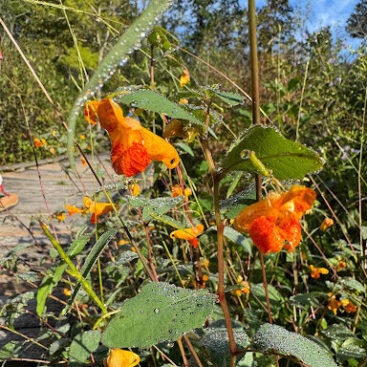
Another flower that hummingbirds visit during this time, which, coincidentally, is the next color of our rainbow, is orange jewelweed. These flowers are bright orange and shaped like little cornucopias, holding all sorts of delicious nectar for hummingbird, butterflies, and bees alike. Jewelweed is also called spotted touch-me-not because of their exploding seed pods. When the seed pods are just right, they take very little pressure before bursting open. It’s a really smart adaptation for jewelweed. It attracts hummingbirds that feed on the nectar, then as the hummingbird is moving from flower to flower, its wings or its body touches a seed pod and it explodes, the seeds flying through the air to land in the nearby soil.
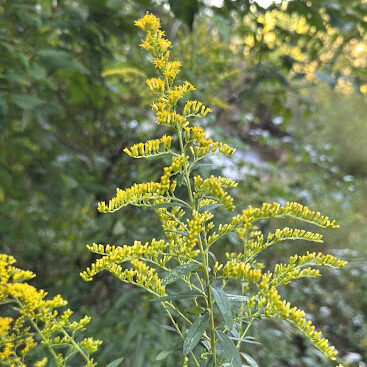
The next color is yellow, and this is a pretty easy one. Just choose any of the over 30 species of goldenrod that we have in Pennsylvania. Goldenrod often blankets the landscape in a rich, golden-yellow carpet with flowers that are beneficial for so many pollinators, like bees and monarch butterflies.
September is the month I most associate with monarch butterflies. Signaled by the cooler days, the monarchs of the “super generation” that fly south begin their journeys. Similar to the hummingbirds, this super generation will fly nearly 3,000 miles south to Mexico, where they overwinter. This same generation will wake up, mate, and then fly back north before laying eggs on milkweed. Typically it takes around 4–5 generations of monarchs before they have completed their round-trip. September is the time to wish monarchs well, whether you see them feeding on goldenrod or flying a couple hundred feet above the ground at a local hawkwatch.
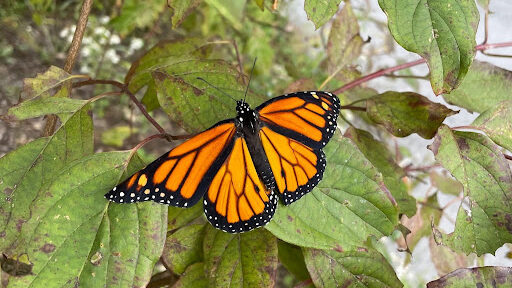
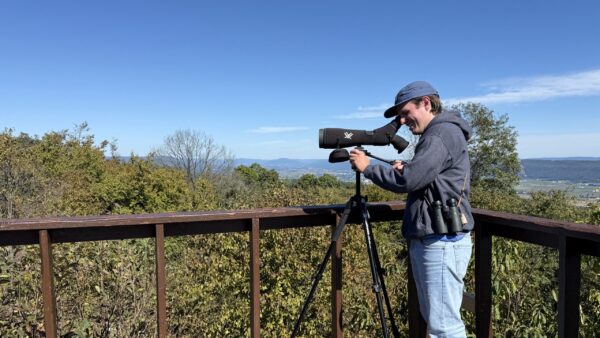
Hawkwatches are a great place to see migration in action, whether you’re spotting a monarch fluttering against the sky or seeing hawks soaring in the distance. September is the height of Broad-winged Hawk migration in Pennsylvania. Broad-wings can be spotted flying solo or in kettles (groups of hawks flying or circling together to gain altitude) of hundreds of birds. Stone Mountain hawkwatch is roughly a 30-minute drive from Shaver’s Creek, and it is a great place to watch for hawks in the fall, boasting commanding views of both Stone Valley and Kish Valley.
Back to the color search. I found a lot of green on my walk. A lot of green stems and green leaves. You could choose really any of these for the color green, but for the purposes of having a flower for each color—and to highlight a really neat one in autumn—we are going to go with turtlehead. I wrote in my previous blog post that sometimes you wonder why things in nature are named the way they are. That is not the case with turtlehead because, when viewed from the side, its hooded shape looks pretty close to a turtle’s head with its mouth open. This design is perfect for bumblebees to squeeze inside to get nectar.
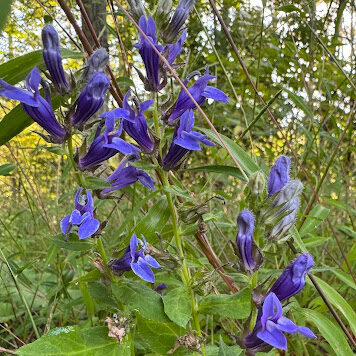
For the next color, blue, we have great blue lobelia. Great blue lobelia (lobelia siphilitica) shares the same genus as cardinal flower (lobelia cardinalis). The plants themselves have a similar shape to each other, and they each add a striking splash of their respective color to the landscape.
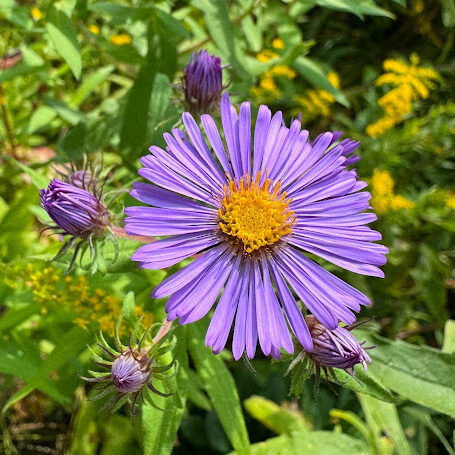
Our final color, purple, can be seen in a variety of different asters, specifically New England aster, a very showy, very purple flower that blooms late in the summer and into the fall months.
Of course, flowers aren’t the only places to see all these colors. The leaves are starting to change their color and fall. And with just a few leaves, you can get red, orange, yellow, green (blue is more difficult to find), and even some dark purples veering into the red category. I’ll often mistake the falling leaves for small birds hopping around among the branches. September is also a huge month for migrating songbirds like warblers.
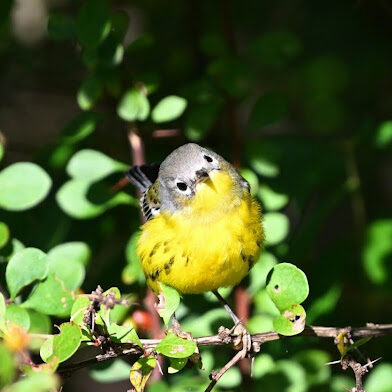
The trick to seeing a mixed flock of warblers in the fall is to follow the Black-capped Chickadees and Tufted Titmice. Imagine that you are a warbler flying south and looking for someplace safe to stop and feed. What could possibly be more welcoming than finding a spot where chickadees and titmice, local year-round residents, are hopping around and calling. The more warblers that join a mixed flock, the more protection there is from potential predators. So if you really want to see some fall warblers, listen for the chickadees. And always carry your binoculars in the fall, because you never know what you might stumble upon.
I think I’ve come to realize that what I really enjoy about these seasons are the changes that occur in them, and how one day can be drastically different in temperature, weather, birds, and plants blooming from the previous. That day, in turn, will be different from the next, and the one after that.
Nature is constantly changing. And yet, there is a consistency to it, a cycle. Come this time next year, you would be able to see the same goldenrod flowering, or wake up one morning to see a similar flock of warblers hopping around the trees at the Boardwalk.
There is a comfort to be found in the balance of changes and constants, knowing that despite so many changes, there is still beauty to be found and appreciated. As we shift from one season to another, it’s important to take the time to notice those changes happening around you, after all, it’ll be a year until you can see them again.